Buy the dependency
Power before AI
An AI company is, financially, an energy and compute company in disguise. The layer that everyone else has to buy from is frequently the better risk-adjusted position.
The economy of 2040 is best understood not as separate sectors, but as a single technology stack where each layer is built on (and unlocked by) the layer beneath it. Energy powers compute. Compute trains intelligence. Intelligence commands machines. Machines build the physical world and carry civilization off-planet. Redrock invests down this stack, where the dependencies are.
Read it bottom to top. Each layer is only as strong as the one supporting it, which is why the base layers are where the durable value accrues.
Every layer is a customer of the layer below it. AI cannot scale without compute; compute cannot scale without energy. Whoever owns the foundation captures value from everything built on top.
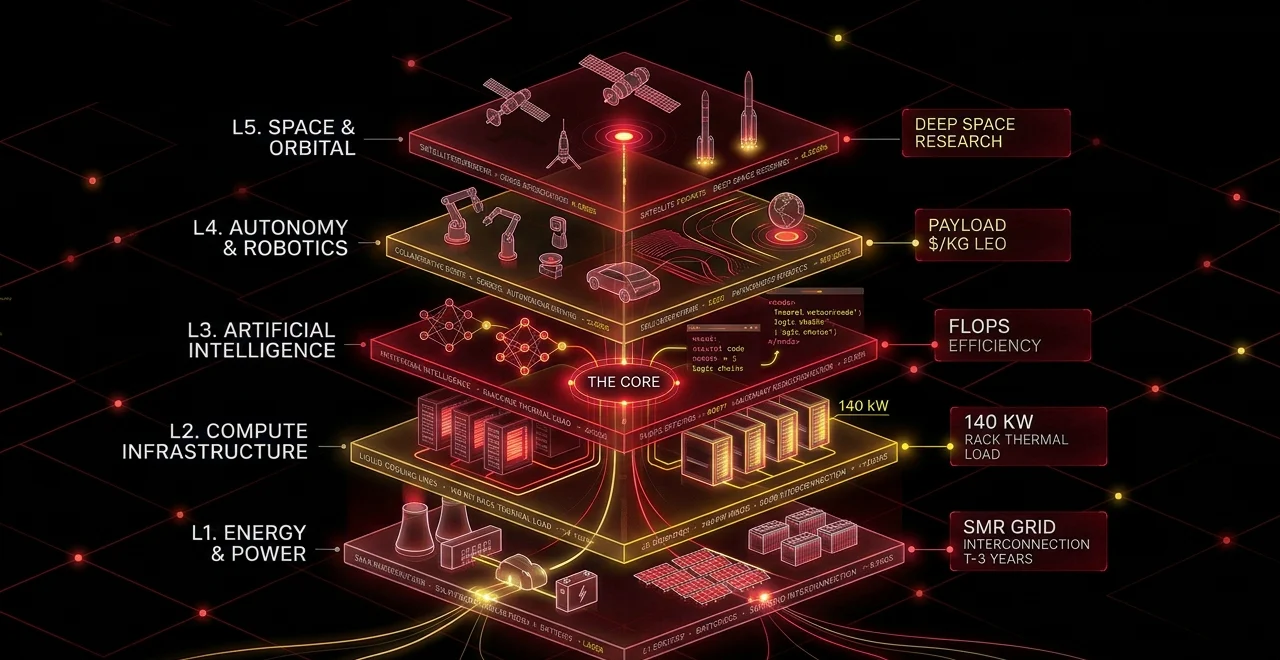
Nothing in the modern economy happens without power. AI data centers, manufacturing, transportation and space launch are all, at root, energy problems. Cheap, abundant, reliable power is the single largest constraint on growth, which is why nuclear, SMRs, solar and storage sit at the bottom of the stack and at the top of our priority list.
If energy is the fuel, compute is the raw material of the 21st-century economy. Semiconductors and data centers are the factories where intelligence is forged. Demand is effectively unbounded (every advance in AI consumes more of it) making compute infrastructure one of the most defensible positions in the entire stack.
Artificial intelligence converts energy and compute into cognitive work that scales without hiring. For the first time, output can grow without a proportional increase in human headcount. This decoupling of productivity from labor is the central economic event of the next two decades.
AI gives machines a brain; robotics gives them a body. Humanoids, autonomous vehicles and lights-out factories extend digital intelligence into the physical world, building, moving and making with falling marginal cost. Manufacturing becomes autonomous; the cost of physical goods follows the cost of software down.
Once energy, compute, intelligence and autonomy compound on Earth, they point outward. Falling launch costs turn space from a government program into an industrial economy, manufacturing, energy, communications and resources beyond the planet. It is the top of the stack because everything below it has to work first.
These are not five bets. They are one bet, expressed five ways, a single compounding system. Redrock invests in the dependencies between the layers, where a breakthrough at the bottom multiplies the value of everything above it.
The layers don't just stack; they feed back. Cheaper energy makes everything above it cheaper, which raises output, which funds more energy. The loop is the thesis.
Higher GDP funds the next generation of energy, and the cycle accelerates. This is the engine behind McKinsey's projection that frontier arenas compound market value roughly four times faster than the rest of the economy through 2040.
| # | Technology | Role in the stack |
|---|---|---|
| 01 | Advanced Nuclear & SMRs | Abundant baseload power for the entire stack |
| 02 | Solar & Energy Storage | Cheap marginal energy and grid resilience |
| 03 | Semiconductors | The raw material of compute |
| 04 | AI Data Centers | Where intelligence is trained and served |
| 05 | Foundation Models & Agents | Digital labor at scale |
| 06 | Humanoid Robotics | Physical labor at scale |
| 07 | Autonomous Mobility | Self-driving logistics and transport |
| 08 | Advanced Manufacturing | Lights-out, software-defined production |
| 09 | Reusable Launch | Collapsing the cost of reaching orbit |
| 10 | Space Infrastructure | Satellites, comms and off-world industry |
The companies most people read about sit at the top of the stack. The most durable returns often come from the infrastructure layers everyone above them depends on.
An AI company is, financially, an energy and compute company in disguise. The layer that everyone else has to buy from is frequently the better risk-adjusted position.
SpaceX (launch + Starlink), Tesla (energy + autonomy + Optimus) and xAI (intelligence) span every layer of the stack at once, which is precisely why the ecosystem compounds. See the Opportunity.
This is a fifteen-year framework, not a quarter. Redrock structures private-market access designed to hold through the compounding, not trade the noise.
Frontier technology is held back by steel, power and permits long before it is held back by ideas. These are the choke points that set the pace of every layer.
Grid interconnection timelines, SMR licensing and battery storage deployment decide when a site can draw power at all.
Power per rack, liquid cooling and advanced packaging decide how much compute a building can actually hold.
Actuator supply chains, power-to-weight and manufacturing capacity decide whether a robot leaves the demo floor.
Capital intensity and power purchase agreements decide which projects finance and which stay on paper.
Redrock underwrites the bottleneck before the headline. Clearing them one layer at a time is hard. Clearing them across every layer at once is what makes an operator scarce, and it is the second half of what Redrock backs.
Energy, compute, intelligence, autonomy and space. The 2040 model points at one operator sitting across all five.
Explore the Opportunity